
No products in the cart.
Account
Login
Cart
 Order Sample
 View Bestsellers
 Fast Delivery
Hexagon Tiles
Hexagon wall tiles bring geometry and character to any surface – from compact bathroom shower walls to statement kitchen splashbacks and hallway floors. At Top Ceramics you’ll find hexagon tiles in white, black, green and mixed colourways, available as ready-to-fit mesh-backed mosaic panels. Up to 40% below high-street prices. Free UK samples on every product.
Filters
Showing all 24 results


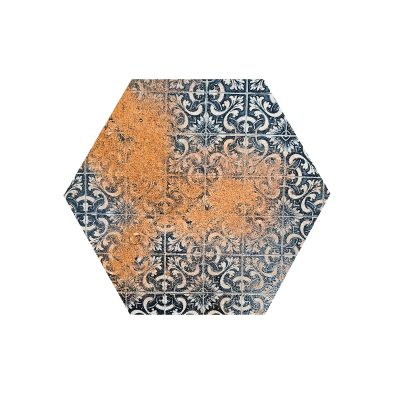


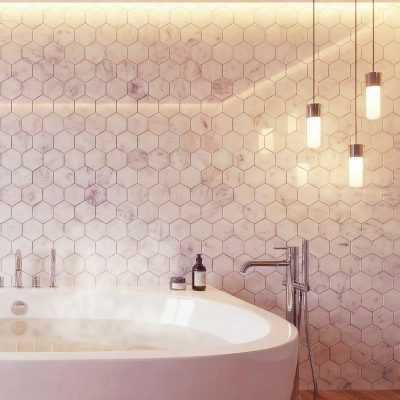
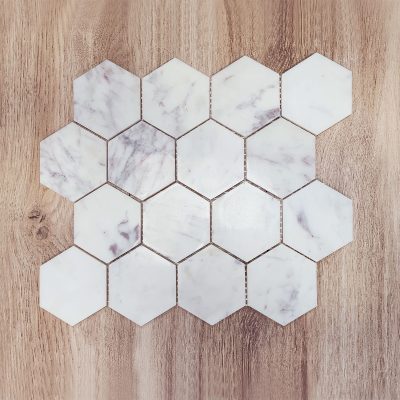
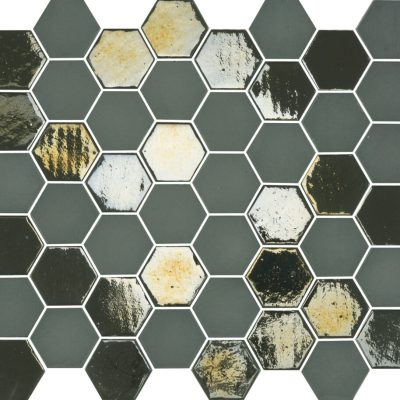


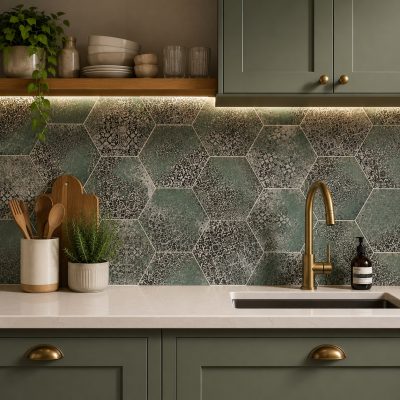

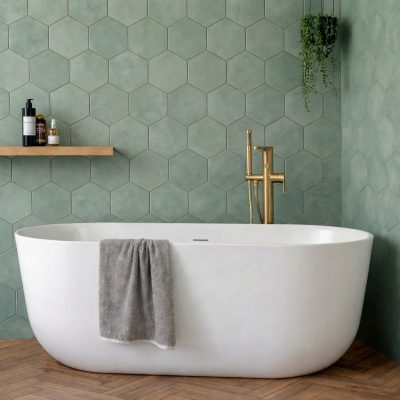
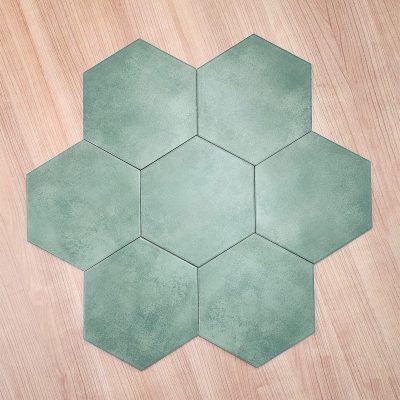


Shop hexagon tiles by colour
Top Ceramics offers hexagon wall tiles in a wide palette – from classic white and bold black through to sage green, turquoise and mixed multicolour mosaics. Each colour is available as a free UK sample so you can assess the finish and tone in your own lighting before committing to a full order.
White hexagon tiles
White hexagon tiles are one of the most enduringly popular tile choices in the UK, and it is easy to see why. Their clean geometric shape against a neutral background opens up small rooms, reflects both natural and artificial light, and works across an exceptionally broad range of interior styles – from Victorian-inspired bathroom floors through to minimal Scandinavian wet rooms.
The satin finish on our white hexagon mosaic panels gives a soft sheen that sits between gloss and matt, making it easier to maintain than a high-gloss surface while still keeping the look fresh and bright. Panel dimensions of 27×32 cm mean these tiles fit quickly on walls and floors alike, with the mesh backing ensuring consistent spacing throughout.
They work particularly well alongside metro tiles in a mixed-format bathroom scheme, where the contrasting shapes add visual rhythm without introducing a second colour. Browse our full range of white hexagon tiles – available in satin finish on 27×32 cm panels, suitable for both walls and floors.
Black hexagon tiles
Black hexagon tiles make a confident, design-led statement that is particularly effective in industrial, minimalist and contemporary bathroom schemes. The deep, uniform tone of each hexagon is brought into sharp relief by the grout lines between them – a white or pale grey grout creates the classic high-contrast honeycomb pattern that has been a staple of sophisticated bathroom design for decades.
Paired with warm brass or brushed-gold fixtures and fittings, black hexagons deliver one of the most sought-after looks of 2026. The satin finish on our black hexagon mosaic panels keeps the surface easy to wipe down and reduces the visibility of watermarks compared to a high-gloss alternative. Our black hexagon tiles come in satin finish on easy-to-fit 27×32 cm mesh-backed panels – ideal for creating a bold feature wall in any bathroom.
Green hexagon tiles
Green hexagon tiles are one of the defining tile trends of 2026, reflecting the broader move towards biophilic interiors that draw on natural colour and organic form. Our hexagon mosaic in a green and khaki mix brings together several complementary earthy tones on a single 33×29.8 cm panel – the result is a surface that has depth and warmth rather than the flat uniformity of a single-colour tile.
The mix of sage, olive and khaki tones pairs naturally with warm wood vanity units, rattan accessories and brushed brass hardware, making it an ideal choice for a bathroom styled as a calm, nature-inspired retreat. The same tile works equally well as a kitchen splashback or a half-height feature wall behind a bath. Explore our green hexagon tiles – available in a khaki mix on 33×29.8 cm panels.
Blue & turquoise hexagon tiles
Blue and turquoise hexagon tiles suit coastal, Mediterranean and art-deco inspired interiors particularly well. Powder blue and duck-egg hexagons give a bathroom a calm, airy quality that works naturally with white grout and chrome fixtures, while deeper petrol or teal tones create a richer, more enveloping atmosphere.
Mixed turquoise panels – where several shades of blue and blue-green appear on a single sheet – produce a subtle wavy or ombre effect that is especially effective in shower enclosures and around freestanding baths. If you don’t see a specific blue or turquoise hexagon in our current range, contact our team for current stock – the colour palette is updated regularly.
Mixed & multicolour hexagon mosaics
Mixed hexagon mosaics combine two or more colours on a single panel, creating a patchwork or gradient effect that is far more visually complex than any single-colour option. The interplay between tones means that the finished surface reads differently depending on the light conditions and the grout colour – a dark charcoal grout will make each individual hexagon stand out sharply, while a close-toned grout blends the surface into a more unified field of colour and texture.
Mixed mosaics work well as a single feature wall or floor zone, particularly when the surrounding tiles are kept plain and neutral to let the pattern breathe. For the full range of panel-format options, see our mosaic tiles collection.
Hexagon tile sizes & formats
The size of a hexagon tile has a direct effect on the finished appearance – smaller hexagons produce a more intricate, detailed surface with a traditional quality, while larger formats read as more contemporary and lay more quickly. Choosing the right format for your room and project type is as important as choosing the right colour.
Small hexagon tiles (21.5×25 cm panels)
Smaller hexagon mosaic panels – around 21.5×25 cm – contain a higher density of individual hexagons per sheet, which gives the finished wall a fine, detailed pattern reminiscent of Victorian floor tiling and period-style bathrooms. This format is particularly well suited to small bathrooms, shower niches, and splashback areas where the intricacy of the pattern can be appreciated at close range.
The smaller individual tile size also makes it significantly easier to cut around pipes, shower fittings and irregular wall shapes – fewer cuts are needed, and those that are required are simpler to execute with a standard tile cutter.
Medium hexagon mosaics (27–33 cm panels)
The medium panel formats represent the most popular size in the Top Ceramics hexagon range, and for good reason. They are large enough to lay quickly over a standard bathroom or kitchen wall, but small enough to handle comfortably on site and cut without specialist equipment.
All panels in this size range are supplied on a fibre mesh backing, which holds each hexagon in precise alignment and maintains a consistent grout joint across the entire sheet. This mesh-backed construction means that installation time is significantly shorter than laying individual hexagonal tiles, and the finished grout lines are perfectly uniform throughout. This format works equally well on walls and floors.
Large format hexagon tiles
Large-format hexagon tiles – typically individual porcelain or ceramic pieces rather than mosaic panels – produce a markedly more contemporary result than smaller mosaics. The reduced number of grout lines gives the surface a cleaner, more seamless quality that suits large, open-plan bathrooms and modern kitchen schemes.
Because individual large hexagons are heavier and require more precise alignment than mesh-backed panels, professional installation is recommended for the best result – any misalignment between tiles is more apparent at larger scale. If you are planning a large-format hexagon floor or feature wall, our team can advise on suitable adhesive specifications and installation approach.
Where to use hexagon tiles
Hexagon tiles in ceramic and porcelain formats suit almost every room in the home – their geometric versatility means they work as floors, walls, feature surfaces and accent details across bathrooms, kitchens, hallways and living spaces.
Hexagon tiles in bathrooms
The bathroom is the most natural setting for hexagon wall tiles – the format has been used in wet rooms and bathrooms since the late nineteenth century, and it remains as relevant now as it was then.
Ceramic and porcelain hexagon mosaics are fully impermeable and resistant to humidity, steam and standing water, making them a reliable long-term choice for shower enclosures, bath surrounds and full-wall applications.
The satin finish available across our hexagon range is particularly well suited to bathroom use: it delivers a refined appearance without the high reflectivity of gloss that can make watermarks and soap residue immediately visible, and it offers better grip underfoot than a polished surface when used on floors.
You can also order a free UK sample of any hexagon tile before you buy – essential when assessing how a colour reads in your specific bathroom lighting. For the broader context of tiles that work well in wet rooms, explore our bathroom tiles collection.
Hexagon tiles on kitchen floors
The hexagon pattern has a long history on kitchen floors – it was a staple of Victorian and Edwardian domestic kitchens in black-and-white ceramic, and that classic combination is as popular in 2026 as it has ever been.
For kitchen floor use, always choose a tile with a matt or satin finish and a minimum R9 slip-resistance rating – a glossy hexagon mosaic is not suitable for kitchen floors where water, oil and food debris are routine hazards.
One practical advantage of the hexagon pattern on kitchen floors is that the grout network – which runs in multiple directions rather than the straight horizontal-vertical grid of square tiles – does a better job of concealing everyday surface grime between cleaning sessions.
Feature walls with hexagon tiles
A single hexagon feature wall is one of the most effective ways to introduce pattern and colour into a room without committing to an all-over tiled look. The principle is straightforward: one wall in a bold hexagon colour – emerald green, charcoal black, deep navy – with the remaining three walls in a plain neutral tile or painted finish.
The contrast does all the work, and the result reads as considered and confident rather than busy. Feature walls tiled in hexagon mosaics work behind a bed in a bedroom, behind a freestanding bath in a bathroom, or as a hallway entrance wall. Before ordering, take advantage of our free UK sample service – seeing the colour in your actual light conditions is the only reliable way to confirm your choice.
Hexagon tiles in hallways
The hallway is a demanding environment for floor tiles – it takes more foot traffic than almost any other domestic surface and needs to be easy to clean. The classic black-and-white hexagon floor pattern is one of the most proven solutions: the contrasting tones conceal everyday dirt well, the pattern holds its visual interest over time, and it is straightforward to maintain with standard cleaning products.
For hallway use, select tiles with a minimum PEI hardness rating of 3 (ideally 4 for busy households) to ensure the glaze withstands repeated foot traffic without wearing through. Hexagon mosaics in smaller panel formats are particularly practical for hallways with irregular layouts, bay shapes or multiple doorways, as the individual tiles are easy to cut around architraves and door frames.
Mixing hexagon with metro tiles
Combining hexagon mosaics with metro tiles in the same bathroom or kitchen is one of the most effective mixed-format approaches in contemporary tile design. The two shapes complement each other well because they share a common heritage – both formats originated in the early twentieth century and share a clean, geometric quality – while offering enough contrast in form to make the combination visually interesting.
The most common approach is to use metro tiles as the primary wall surface and introduce hexagon tiles as an accent in a shower niche, as a floor, or as a half-height border. Keeping both formats in the same colour family – white metro tiles with white hexagons, for example – lets the shape contrast do the work without introducing additional colour complexity. Alternatively, a white metro tile wall paired with a contrasting coloured hexagon floor – green, black or mixed – creates a room with a clear distinction between the two planes.
FAQ
What size are hexagon wall tiles?
Hexagon tiles at Top Ceramics are supplied as mosaic panels rather than individual tiles. Panel sizes in the range are for example 21.5×25 cm, 26×30 cm, and 33×29.8 cm. All panels are supplied on a mesh backing that holds the hexagons in precise alignment and maintains consistent grout joint spacing throughout installation.
Can hexagon tiles be used on floors?
Yes – provided the tile has an appropriate slip-resistance rating. The satin-finish hexagon mosaic panels in our range are rated for both wall and floor use. For bathroom and kitchen floors, a minimum R9 slip-resistance rating is the baseline requirement; R10 is recommended for wet-room and shower-floor applications.
Matt-finish hexagon tiles generally achieve higher slip-resistance ratings than gloss and are the most suitable option for any floor that will be regularly exposed to water. Always check the individual product specification before ordering for floor use.
What grout colour goes with white hexagon tiles?
The choice of grout colour with white hexagon tiles determines the overall character of the finished surface more than almost any other single decision. A bright white grout produces a seamless, airy result where the hexagon pattern is present but subtle – the tile and grout read as a single unified surface.
A mid-grey grout introduces definition between each hexagon and gives the pattern more visual presence without the starkness of a dark contrast. A charcoal or near-black grout creates the most graphic, high-contrast result – the hexagon pattern becomes the dominant visual feature of the wall or floor. As a general guide: use white or light grey grout in small rooms where you want the surface to recede; use dark grout in larger rooms or as a deliberate design statement.
Are hexagon tiles still in style in 2026?
Yes – hexagon tiles remain one of the most searched-for tile formats in the UK in 2026. The format has sustained its popularity because it offers genuine design flexibility: the same shape reads as Victorian and traditional in black-and-white ceramic, as contemporary and graphic in large-format porcelain, and as organic and artisan in mixed-colour mosaic panels.
How do you cut hexagon tiles?
Cutting hexagon mosaic panels is more straightforward than it might appear because the mesh backing holds the individual tiles in place during cutting. For straight cuts across a panel, a standard manual score-and-snap tile cutter or a wet saw with a diamond blade will both produce a clean result.
For cuts around curved or irregular obstacles – pipes, shower fittings, wall sockets – a diamond-tipped hole saw or angle grinder with a tile-cutting disc gives the most control. When cutting individual hexagon tiles within a panel, tile nippers are the most practical tool for removing small amounts of material around awkward shapes.
As a general rule, always make test cuts on a spare tile or offcut before cutting from a full panel, and add a 10–15% wastage allowance to your order quantity when planning a layout with many cuts or a diagonal orientation.