
Account
Login
Cart
 Order Sample
 View Bestsellers
 Fast Delivery
Metro Tiles
Filters
Showing 49–60 of 60 results




What are metro tiles?
The history of metro tiles
Metro tiles take their name from the underground railways of New York and Paris, where they were first installed at the turn of the twentieth century. Their defining characteristics – a smooth, rectangular white face and a classic running-bond (brick) pattern – were chosen for entirely practical reasons: the glazed surface was hygienic, easy to wipe clean, and helped reflect gaslight in the dimly lit tunnels below ground.
What began as a utilitarian solution quickly captured the imagination of designers and architects above ground, and metro tiles soon appeared in bakeries, butchers' shops, and domestic kitchens throughout Europe and America. The remarkable thing is how little the format has changed in over a hundred years – the same proportions that worked in 1904 continue to define contemporary interiors today, which is perhaps the clearest evidence of a truly timeless design.
Metro tiles vs subway tiles – is there a difference?
In short: no. The term “metro tiles” is the standard in the UK and most of Europe, while “subway tiles” is the equivalent used across the United States and Canada. Both names describe the same rectangular wall tile with a 2:1 aspect ratio.
The dimensions are also virtually identical: the UK reference size is 10×20 cm, while the US standard is 3×6 inches – the difference amounts to just a few millimetres. Whether you search for metro or subway tiles, you are looking at the same product.
Metro tile colours available at Top Ceramics
Top Ceramics offers a full spectrum of coloured metro tiles – from crisp classic white to deep navy and rich burgundy. Each colour is available in several finishes, so you can fine-tune the look to suit your room and lighting conditions.
White metro tiles
White remains by far the most popular choice, and for good reason. A white metro tile visually enlarges a room by bouncing light off its surface, and it works effortlessly across decorating styles – whether you are going for a clean Scandinavian aesthetic, an industrial look with exposed steel fixtures, or a traditional kitchen feel.
Browse our full range of white metro tiles – from bright gloss to soft matte finishes – and pair them with a contrasting dark grout for a graphic, contemporary effect or with matching white grout for a seamless, airy result.
Green metro tiles
Green has firmly established itself as the defining tile colour of 2024–2026, and our green metro tiles cover the full tonal range – from dusty sage and warm olive through to deep forest and jewel-like emerald.
These shades work beautifully as a kitchen splashback alongside natural wood cabinets and brass hardware, or as a statement accent wall in a bathroom. Sage and muted olive tones keep a room feeling calm and organic, while darker forest and emerald hues deliver an unmistakably bold, design-led finish.
Blue metro tiles
Blue metro tiles span a wide tonal range that makes them one of the most versatile colour options in the collection. At the lighter end, powder blue and duck-egg tones bring a soft, coastal quality to a bathroom or utility room.
Moving deeper, blue metro tiles in petrol and teal – including metro tiles turquoise – add richness and depth without feeling heavy. At the darkest end of the spectrum, a navy metro tile creates a striking, almost lacquered effect that pairs exceptionally well with polished brass or matte-black fittings. All blue tones are available in gloss and matt finishes.
Pink & blush metro tiles
Blush and dusty pink metro tiles are a popular choice for bathrooms styled in the art déco or vintage tradition. The warm, rose-tinted tones pair naturally with warm white grout, copper or rose-gold fixtures, and soft lighting to create an interior that feels both elegant and personal. Pink tiles work well-used across a full wall, but are equally effective as a half-height band above a darker floor tile.
Burgundy & dark-tone metro tiles
For those who want their tiling to make a genuinely bold statement, our dark-tone range – including burgundy, slate and charcoal – delivers exactly that. These shades are ideally suited to feature walls in bathrooms, alcoves, and open-plan kitchen-diners where a single surface needs to anchor the entire design. Paired with minimal, neutral surrounding finishes, a deep burgundy or charcoal metro tile creates a space with real visual presence and character.
Metro tile sizes & finishes explained
10×20 cm vs 10×30 cm – which to choose?
The 10×20 cm format is the original and still the most widely used – it is the size most people picture when they think of a metro tile. Its near-square proportions emphasise the running-bond pattern, making it the ideal choice for smaller rooms, cloakrooms, and any space where you want the classic subway aesthetic front and centre.
The 10×30 cm format, by contrast, produces a more elongated, architectural feel. The longer tile reduces the number of horizontal grout lines and gives walls a sleeker, more contemporary look. As a rule of thumb: use 10×20 cm in small and medium-sized rooms where you want a traditional result; choose 10×30 cm in larger bathrooms, open-plan spaces, or where a more modern finish is the priority.
Gloss, satin and matt finishes compared
Choosing the right surface finish is as important as choosing the right colour. Here is how the three main options compare:
- Gloss – reflects light strongly, making a room feel larger and brighter. The surface is easy to wipe clean. The trade-off is that fingerprints and watermarks are more visible, which can be a consideration in a busy kitchen.
- Satin – strikes a balance between the two extremes. It has a gentle sheen that catches the light without the full reflectivity of a gloss surface. Smears are less obvious, and the overall effect feels slightly softer and more contemporary.
- Matt – has no reflective quality at all, giving a quieter, more designedly result. It hides surface marks better than gloss in day-to-day use, but the grout lines require more careful maintenance. An excellent choice if you want an understated, tactile finish.
As a general guide: in small or low-light bathrooms, gloss will open the space up most effectively. In kitchens, especially around the hob, satin or matt offers a more practical and elegant long-term finish.
Flat vs bevelled edge metro tiles
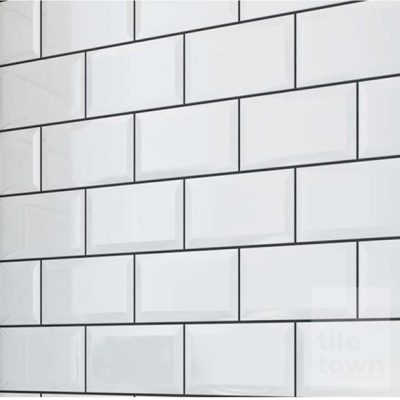
Flat (square-edge) metro tiles have a clean, flush surface that gives walls a sharp, minimal appearance – the right choice for contemporary and modernist interiors where you want nothing to interrupt the surface plane. Bevelled metro tiles feature a gently angled edge on all four sides, creating a shallow shadow line between each tile that adds texture, depth and a distinct handcrafted quality.
The bevel is particularly effective in traditional and period-inspired settings – Victorian, farmhouse, and art déco schemes all benefit from its subtle three-dimensional quality. Not sure which edge to choose? Read our in-depth guide to bevelled vs flat metro tiles before you order.
Where to use metro tiles in your home
Metro tiles in bathrooms
The bathroom is the natural home of the metro tile – its ceramic glaze is fully waterproof, the smooth surface cleans effortlessly, and its proportions are suited to both large and compact spaces.
The most popular applications include the full-height wall behind a basin, a tiled shower enclosure or bath surround, and – in smaller rooms – lining every wall to create a cohesive, spa-like finish. Metro bathroom tiles are equally effective in a cloakroom, where even a small run of colour or texture makes an outsized visual impact. For a full overview of what works best in wet rooms, explore our bathroom tiles collection.
Metro tiles as kitchen splashbacks
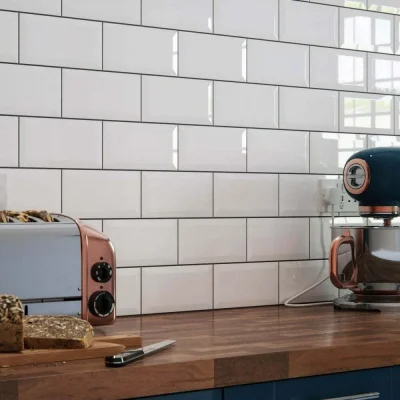
After the bathroom, the kitchen splashback is the most common application for metro tiles, and it is easy to understand why. The ceramic glaze resists grease and moisture without any specialist treatment, and a splashback can be wiped down in seconds – an important consideration in a cooking environment.
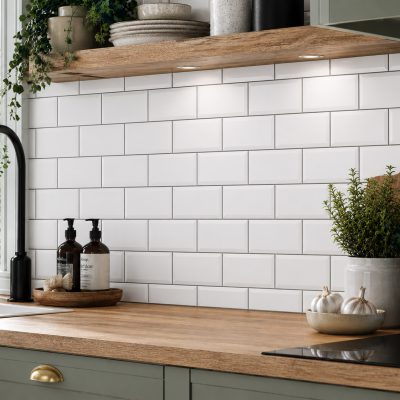
Metro tiles adapt remarkably well to different kitchen aesthetics: a gloss-white tile with a dark charcoal grout creates a graphic, urban feel that suits modern handleless kitchens, while a sage-green tile paired with a warm putty grout and brass fittings immediately reads as relaxed and artisan. Browse our dedicated kitchen wall tiles collection for the full range of splashback-ready options.
Feature walls with metro tiles
Metro tiles are not limited to wet or cooking zones – they work equally well as a feature wall in a living room, entrance hallway, or commercial space such as a café or restaurant. In these settings, the tile becomes a design statement rather than a purely functional choice.
Choosing a bold colour such as emerald green, deep navy or burgundy, and laying it in the classic running-bond pattern, creates a wall with strong visual presence that needs very little else around it to make an impression. The relatively small format of each tile also means that imperfections in an older wall are well disguised.
How to order metro tiles from Top Ceramics
Ordering from Top Ceramics is straightforward and takes place entirely online – from browsing and selecting samples through to check out and delivery tracking, the whole process is managed through our website.
Free sample service
Before committing to a full order, we strongly recommend ordering a free sample. Colours and finishes can look very different under domestic lighting than they do on a screen, and a physical sample lets you check the tile against your existing fixtures, grout colours and cabinetry before you spend anything.
To request one, simply click the “Buy Sample” button on any product page – samples are dispatched promptly and arrive within a few working days.
Calculating how many metro tiles you need
Follow these steps to arrive at an accurate quantity:
- Measure the wall area you want to tile (length × height = m²). Deduct any large fixed openings such as windows or doors.
- Add a 10% wastage allowance for cuts and breakages. If your wall has an irregular shape – around a window reveal or a chimney breast, for example – increase this to 15%.
- Check the product page for the tile count per m².
Why choose Top Ceramics for metro tiles?
Metro tiles, also known as subway tiles, are one of the most recognisable wall tile styles. First used in the New York subway in the early 1900s, they've since become a design classic in homes across the world. Loved for their simple rectangular shape and timeless appeal, metro tiles are perfect if you want a wall finish that feels both traditional and modern at the same time.
At Top Ceramics, our range covers 10 colour options in various sizes, including 10×20 cm, 10×30 cm, 7.5×30 cm and 25×6 cm. Tile thickness ranges from 7 to 10 mm. With prices starting from £15.89 per m², the collection is designed to work for smaller jobs like kitchen splashbacks and for larger full-room projects alike. Our gloss, satin, matt and bevelled options mean you can adapt the same format to very different finished looks – all with the same consistent quality across the board.
FAQ
Most metro tiles are designed for walls only, as they are typically made from ceramic and may not provide the durability or slip resistance required for flooring.
This depends on the tile size. For example, smaller formats like 10×20 cm will require more tiles per square metre than larger formats such as 10×30 cm. On average, you can expect around 40–60 tiles per m².
Bevelled metro tiles have slightly angled edges, creating a framed effect around each tile. This detail adds depth and is often used in more traditional or classic interiors.
There is no real difference – “metro tile” and “subway tile” are two names for the same rectangular wall tile style, originally used in early 20th-century underground stations.
Metro tiles come in several standard sizes, including 10×20 cm, 10×30 cm, 7.5×30 cm, 25×6 cm and other. The size you choose will affect the overall look and layout pattern.