Account
Login
Cart
 Order Sample
 View Bestsellers
 Fast Delivery
Bevelled vs flat metro tiles – complete comparison
The difference between bevelled and flat metro tiles lies in their edge profile and the way they interact with light. Bevelled tiles have angled edges that create shadow and depth, while flat tiles offer a smooth, uninterrupted surface. But which option will truly enhance your space rather than simply follow tradition?
Key takeaways
- Bevelled metro tiles add depth, shadow and traditional character.
- Flat metro tiles create a cleaner, more minimalist look.
- Interior style should guide the choice more than trends.
- Both options remain timeless when matched thoughtfully to the space.
What is the difference between bevelled and flat metro tiles?
Bevelled and flat metro tiles differ primarily in their edge detail and visual effect. Bevelled tiles feature sloping or angled edges that form a subtle frame around each tile, creating definition between units. Flat metro tiles, by contrast, have a straight, sharp edge that produces a clean, continuous surface once installed.
This structural distinction may seem minor, yet it significantly affects how the tiles respond to light and how visible the grout lines appear. Bevelled edges catch light and cast fine shadows, while flat tiles allow light to spread evenly across the surface. The result is either a more decorative, articulated wall or a calm, unified backdrop.
Do you know how metro tiles can transform your interior?
Check out our collection of metro tiles and use the Free Tile Visualiser to see how unique your rooms can become!
How do bevelled and flat metro tiles affect the look of a space?
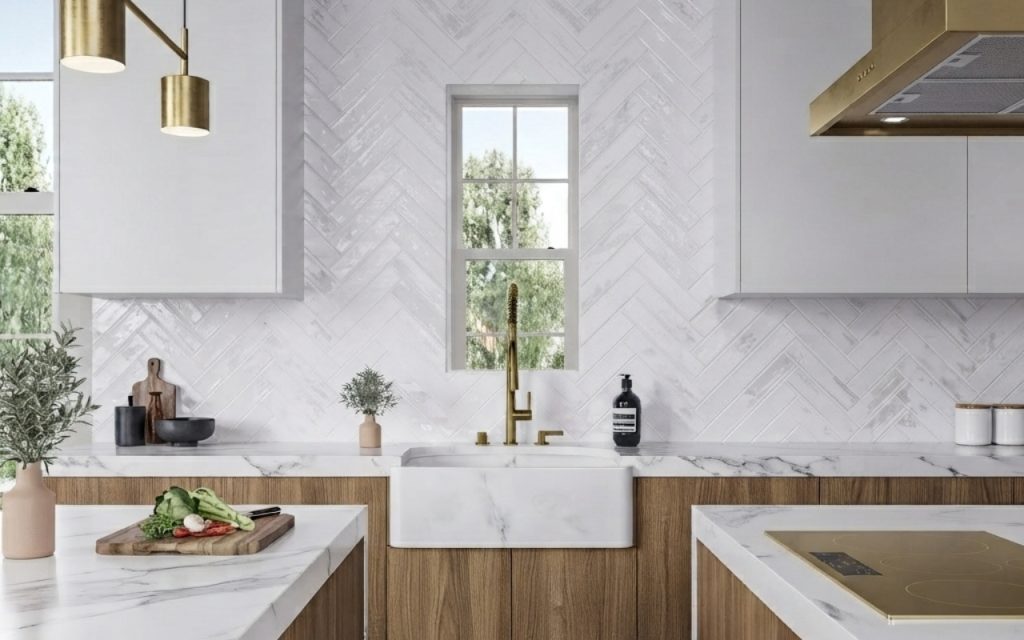
The choice between bevelled and flat metro tiles directly influences whether a room feels detailed and traditional or sleek and contemporary. Bevelled tiles introduce movement and visual layering, particularly in kitchens and bathrooms, where lighting enhances their dimensional quality.
Flat tiles create a quieter effect. Because the surface remains visually consistent, they reduce distraction and allow other elements – cabinetry, fixtures or colour – to take precedence. The decision is therefore less about which tile is “better” and more about how much texture and visual rhythm you want the wall to carry.
If you are unsure which style suits your interior, we offer a Free Tile Visualiser on our website. This tool allows you to test bevelled and flat metro tiles within a virtual version of your room, helping you compare depth, light reflection and overall impact before making a final decision.


Do bevelled metro tiles create more depth and texture?
Yes, bevelled metro tiles naturally create more depth and texture because their angled edges interact with light and shadow. Each tile appears slightly framed, producing a layered effect that feels decorative without being overly ornate.
This added dimension works particularly well in classic, Victorian-inspired or transitional interiors where subtle detail enhances character. In spaces with good lighting, bevelled tiles can make walls feel more dynamic and tactile, adding richness even in neutral colour schemes.
Are flat metro tiles better for minimalist interiors?
Flat metro tiles are often better suited to minimalist interiors because their smooth surface maintains visual clarity. Without angled edges breaking up the surface, the installation feels cleaner and more architectural.
They are especially effective in modern kitchens, Scandinavian-inspired spaces and contemporary bathrooms, where simplicity and proportion matter more than ornament. By reducing shadow lines and texture, flat tiles allow materials and colour to speak more quietly, supporting a refined and balanced aesthetic.
| Aspect | Bevelled Metro Tiles | Flat Metro Tiles |
| Edge profile | Angled, sloping edges | Straight, sharp edges |
| Visual effect | Defined, framed appearance | Smooth, continuous surface |
| Light interaction | Creates shadows and highlights | Reflects light evenly |
| Overall feel | Decorative, classic, textured | Clean, modern, understated |
| Best suited styles | Traditional, Victorian, transitional | Contemporary, minimalist, Scandinavian |
| Impact in small spaces | Adds detail but may feel busier | Feels calmer and more streamlined |
| Design focus | Wall becomes a feature | Supports other design elements |
Both styles remain timeless in their own way – the key lies in choosing the one that complements your interior’s character, rather than competing with it.
Which style of metro tile suits different interior styles?
The style of metro tile you choose should reflect the architectural language of your interior, rather than simply current trends. Bevelled metro tiles naturally complement period properties, shaker kitchens and Victorian-inspired bathrooms, where detail and subtle ornamentation enhance the overall character. Their framed edges echo traditional craftsmanship and pair well with classic fittings, brassware and heritage colour palettes.
Flat metro tiles, by contrast, align more comfortably with contemporary, Scandinavian and industrial interiors. Their clean lines support minimal cabinetry, handleless kitchens and modern sanitaryware without introducing additional visual noise. In transitional spaces, the decision often depends on whether you want the tiles to become a decorative feature or remain a quiet supporting element within the wider scheme.
Conclusion: How should you choose between bevelled and flat metro tiles?
Choosing between bevelled and flat metro tiles ultimately comes down to the atmosphere you want to create. If you value depth, texture and a sense of classic detail, bevelled tiles offer character and subtle drama. If you prefer clarity, simplicity and a more architectural finish, flat tiles provide a clean and contemporary solution.
Neither option is inherently better – the right choice is the one that complements your lighting, layout and interior style. By considering how much visual texture you want the wall to carry, you can select a tile that enhances your space rather than overpowering it.