No products in the cart.
Account
Login
Cart
 Order Sample
 View Bestsellers
 Fast Delivery
Affordable porcelain tiles: are they actually good?
“If it’s that cheap, what’s wrong with it?” It’s the question almost everyone asks when they see porcelain floor tiles starting from £17.89/m² instead of the £25–£40/m² they expected. It’s a fair instinct – with most products, a bargain price does mean a compromise somewhere. But porcelain tiles are one of the few categories where that assumption doesn’t hold up, and it’s worth understanding exactly why before you talk yourself out of a genuinely good, affordable floor.
Contents
hide
Why are Top Ceramics’ porcelain tiles so much more affordable than the high street?
The honest answer has nothing to do with the porcelain tiles themselves and everything to do with how the business is run. Top Ceramics operates as an online-only retailer, importing directly from manufacturers around the world. That structure removes one of the biggest costs baked into a typical high-street tile price: the extra layers of distributors and retail markup that traditional tile shops carry.
An online-only business selling tiles, simply doesn’t carry those costs, which is accurately why the same quality of porcelain can appear on their site at up to 40% below typical high-street pricing. You’re not getting a lesser tile. You’re skipping the costly part of the supply chain that never touched the tile’s actual quality in the first place.
What actually doesn’t change between a £17.89 tile and a £45 tile
This is the part that surprises most people: the core technical specification of a genuine porcelain tile doesn’t move much across price bands because it’s defined by the manufacturing process itself, not the price.
- Water absorption: full-body porcelain, by definition, absorbs around 0.5% water or less – regardless of whether it’s £17.89 or £45/m². This is what makes it suitable for kitchens, bathrooms, wet rooms and even outdoor spaces. A well-priced porcelain tile with a proper full-body composition has the same low-absorption performance as a premium one.
- Density and hardness: porcelain’s strength comes from being fired at high temperature under pressure, compressing the clay body. This happens at the manufacturing stage for the entire product line, not selectively for the premium end of it.
- Suitability for floors: if a tile is genuinely porcelain, it’s built to handle foot traffic and point-loading whether it’s £17.89 or £42.89 – that’s what separates it from a wall-only ceramic tile in the first place, at every price point.
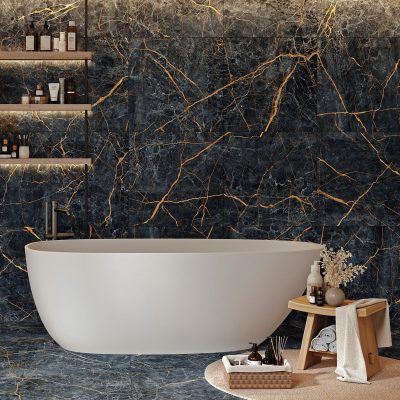

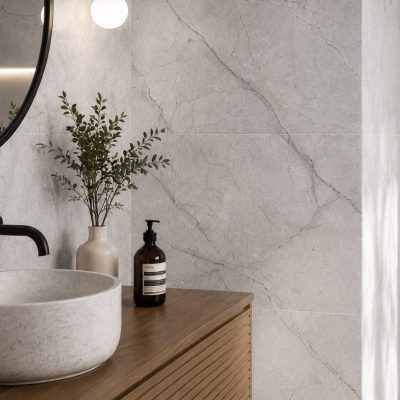
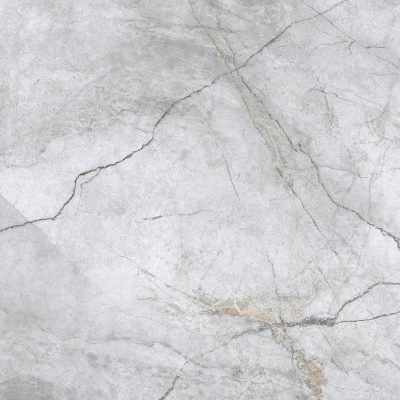
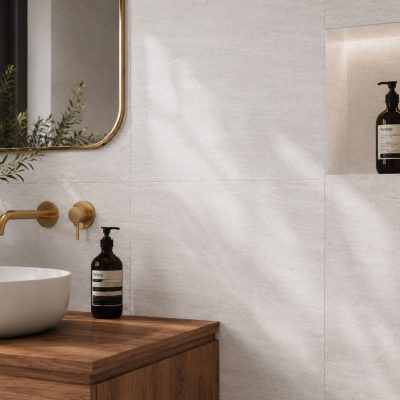

If the core durability doesn’t change dramatically, the extra cost on pricier ranges goes almost entirely into things that affect appearance and format, not structural performance:
- Larger formats (80×80cm, 120×60cm and above) that are harder to manufacture flat and consistent, and more expensive to ship without breakage.
- High-resolution digital printing for realistic marble, stone or wood-effect finishes.
- Rectified edges, cut precisely after firing to allow narrower, sharper grout lines.
- Tighter shade-batch consistency, which matters most across huge, highly visible floor areas.
None of that is “wasted” money if you want a specific large-format, ultra-realistic marble look for an open-plan kitchen-diner. But it also means that if your priority is a solid, genuinely scratch-resistant, good-looking floor in a standard size and finish, you’re not sacrificing performance by choosing the £17.89/m² end of the range – you’re simply opting out of paying for format and finish extras you may not need.
Real customers, real results
Trust in a well-priced tile usually comes down to one question: does it actually hold up once it’s down? Customers who’ve bought from Top Ceramics’ more affordable ranges consistently report exactly what you’d hope for from genuine porcelain – tiles that arrived well packaged, matched what was shown online, and have held their finish through daily family use, without the shade inconsistency or fragility that budget-tile horror stories usually describe. That’s the practical proof that the underlying manufacturing quality doesn’t disappear just because the price is lower.
Example: quality at £17.89/m²
A great example is our Arctic White 60×60 cm porcelain tile, available from just £17.89/m². It offers the hardness and low water absorption you’d expect from genuine porcelain, making it a practical choice for kitchens, bathrooms and everyday family spaces.
It’s also worth keeping an eye on our clearance offers – occasionally, selected porcelain tiles are available for as little as £5 per tile, making premium-looking floors even more affordable.
How to buy budget porcelain with confidence
If you want the reassurance of knowing exactly what you’re getting before you commit to a full room, a few simple checks help:
- Order a free sample first. This is the single best way to judge colour, texture and finish in your own lighting, rather than trusting a screen – and it costs nothing to rule a tile in or out.
- Check it’s described as porcelain, not ceramic, for floor use. The material name on the product page tells you everything about whether it’s rated for foot traffic.
- Look for the water absorption or “full body” description. If it’s listed, it confirms the tile meets genuine porcelain specification, rather than being a lower-grade glazed product marketed loosely as “porcelain style.”
- Buy a little extra. Ordering 10% over your measured area covers cuts, wastage and any future repairs from the same batch – smart practice at any price point, but especially worthwhile on well-priced ranges where topping up later is easy on the wallet.
- Read the finish description carefully, not just the price. Matt, satin, gloss and lappato finishes all wear and clean differently – matching the finish to the room matters more than the price band it sits in.
See it for yourself before you decide.
Browse porcelain tiles from £17.89/m² or see our bestsellers, and order free samples – the best way to judge quality is in your own home, not on a screen.
When budget porcelain is the obvious choice
Affordable porcelain, from £17.89/m², is a genuinely smart pick for any standard-sized room where you are not chasing an oversized, ultra-large-format look. It also makes financial sense in rentals, second homes or shorter-term properties, where paying more for 25-year finish consistency may offer little practical benefit if you are unlikely to enjoy it for that long.
It can be an especially good option when you are covering a larger floor area on a fixed renovation budget, as the money saved on tiles can instead go towards better adhesive, professional installation or underfloor heating – upgrades that can make a noticeable difference to the finished result. Budget porcelain is also worth considering for first-time tilers and DIY projects, as the lower per-tile cost reduces the pressure if a few tiles need replacing while you are learning.
Conclusion
The instinct that “a lower price must mean a compromise” makes sense for many products, but porcelain tiles are manufactured to a technical specification, not priced purely on perceived prestige.
At Top Ceramics, we can offer genuine, full-body porcelain from £17.89/m² because our online-only model removes showroom and distribution costs, not because the tiles themselves are inferior. The extra you pay further up the range buys you format, finish and shade consistency – real things, but not a fundamentally tougher or more functional floor.
If your project doesn’t need oversized formats or bespoke finishes, the budget end of the range isn’t a downgrade. It’s simply the same quality tile, without paying for the parts of the supply chain that never touched it.
If you’re planning a wider renovation and want to see how tiling costs fit into the bigger picture, our guide on how much it costs to tile a bathroom in the UK breaks down labour, materials and total project costs room by room.
FAQ
Is £17.89/m² porcelain genuine porcelain, or a lower-grade product?
If it’s listed as porcelain on a reputable retailer’s product page, it should meet the genuine full-body specification – low water absorption (around 0.5% or less) and a dense, fired clay body suitable for floors. The price reflects supply chain and format costs, not a different underlying material classification.
Why can Top Ceramics offer porcelain at such affordable prices compared to high-street shops?
Because we operate as an online-only business, importing directly from manufacturers from around the world. Without showroom rent, display stock and extra distributor markups, the same tiles can be priced up to 40% lower than typical high-street equivalents.
Will well-priced porcelain tiles look inconsistent or mismatched once laid?
Any porcelain tile, regardless of price, can show natural shade variation between batches – it’s good practice to order all tiles for one room from the same batch and to order a sample first. This isn’t unique to more affordable ranges; it’s standard practice across the whole porcelain category.
Is budget-friendly porcelain suitable for a bathroom or kitchen floor?
Yes – as long as it’s genuine porcelain, its low water absorption and density make it suitable for kitchens, bathrooms and wet rooms at any price point in the range. The material’s core performance doesn’t change between the entry-level and premium ends.
What’s the one thing worth spending more on, even on a tight budget?
Installation quality and adhesive matter more to the finished result than a few pounds per square metre on the tile itself. A well-installed, affordably priced porcelain floor will outperform a premium tile poorly fitted with the wrong adhesive or an unlevelled subfloor.