Account
Login
Cart
 Order Sample
 View Bestsellers
 Fast Delivery
Kitchen tiling ideas: how to choose the best tiles for your Kitchen
Choosing the right kitchen tiles can seem like a challenge, especially with so many styles, colours and materials available. From splashbacks and floor tiles to wall finishes and design trends, this guide will help you make confident choices that combine visual appeal with everyday practicality in one of the hardest-working rooms in your home. Read on!
Key takeaways
- Plan your layout and budget before choosing tiles.
- Porcelain is the best all-round choice for kitchen floors due to its longevity and low maintenance.
- Metro, herringbone and large-format tiles remain among the most popular kitchen tile styles.
- The right tile colour should complement your cabinetry and overall design scheme.
- Anti-slip flooring and suitable grout choices improve long-term practicality.
How to plan your kitchen tiling?
Before you start browsing the best kitchen tiles, it pays to get the practical side sorted first: how much tile you actually need, what it’s realistically going to cost, and whether you’re tiling it yourself or bringing in someone who does this for a living. Nail these three things early, and the fun part – choosing the look – becomes far less stressful.
Measuring your kitchen for tiles
Start by measuring each wall and floor area you plan to tile, in metres, then multiply length by height (for walls) or length by width (for floors) to get the area in square metres. A splashback wall measuring 3m long by 0.6m high, for example, comes to 1.8m² – but you wouldn’t order exactly 1.8m² of tile.
Add a wastage allowance of 10–15% to cover cuts, breakages and the odd mistake, which brings that same wall up to roughly 2.1m². If you’re planning a diagonal layout or herringbone, push that allowance up to 15–20%, since both generate noticeably more offcuts.
A tape measure, a calculator and, ideally, a rough floor plan of the kitchen with dimensions marked on it are really all you need to get an accurate figure before you order anything.
Setting a realistic budget for kitchen tiling
UK tile prices vary hugely depending on material and finish. As a rough guide, budget porcelain or ceramic tiles sit around £10–£20/m², mid-range options run from £20–£40/m², and premium or designer ranges can climb to £40–£80/m² or more.
On top of materials, factor in labour: a tiler in the UK typically charges £150–£300 a day, or works out at roughly £20–£40/m² depending on the complexity of the layout. Put it all together for a fairly typical kitchen – say 12m² of floor plus a 3m² splashback – and you’re looking at somewhere around £600–£1,200 in total for materials and labour combined.
Choosing between DIY and professional tiling
DIY tiling makes sense when you’re working with a simple, regular format laid in a straightforward horizontal pattern, and you’ve already got some general hands-on experience.
It’s a different story once you move into large formats (60×120cm and above), herringbone or mosaic layouts, or a floor with underfloor heating underneath – all of these benefit hugely from a professional’s experience with the right adhesive, levelling system and cutting tools.
Get it wrong on a DIY job and the usual problems are uneven grout lines, tiles that crack because the wrong adhesive or trowel notch was used, and a surprising amount of wasted material from miscalculated cuts.
Kitchen splashback tile ideas
The splashback is arguably the single most visible tiling decision in the whole kitchen – it sits right at eye level, behind the area you spend the most time looking at, and it’s often the one detail that makes a kitchen feel finished rather than half-done.
Metro tiles as kitchen splashbacks – a classic choice
Metro tiles, typically 10×20cm or the slightly smaller 7.5×15cm, remain one of the most popular splashback choices in the UK, and it’s easy to see why. They’re straightforward to lay, simple to keep clean, and flexible enough to suit almost any kitchen style, from a traditional country kitchen to a sleek modern build or a softer Scandi look.
Classic white is still the default, but plenty of kitchens now go for anthracite, sage green or dusty pink instead. Grout choice changes the whole effect: a thick, dark grout against a pale tile gives a graphic, almost industrial look, while a thin white grout keeps things quiet and discreet. If this is the direction you’re leaning towards, have a look at the full metro tiles for kitchen range before deciding on colour and grout together.


Patterned splashback tiles for a bold look
A patterned splashback is one of the easiest ways to add real personality to a kitchen without committing to a bold colour across every surface – it works as a contained accent rather than an overwhelming statement.
Encaustic-style, Moroccan, and geometric patterns are all popular choices at the moment. The general rule of thumb: if your cabinets are neutral – white, grey or plain wood – the splashback has licence to be as bold as you like. Our patterned tiles collection is a good starting point if this is the look you’re after.


Herringbone tile splashbacks
When people search for herringbone tiles kitchen inspiration, what they’re usually responding to is the layout, not the tile itself: the same humble rectangular shape, laid at an angle, suddenly has real movement and a far more elegant finish.
Metro formats (10×20cm and 7.5×30cm) and rectified tiles are the most commonly used sizes for a herringbone splashback. Worth knowing before you order: herringbone generates noticeably more waste than a straight layout, typically around 15%, so it’s worth building that into your quantities from the start rather than discovering it halfway through the job.
Mosaic splashback tiles
Mosaic remains a classic choice directly above the worktop, particularly popular in Mediterranean-style and contemporary kitchens. You’ll find it in various formats, which make installation considerably more straightforward than placing each individual tile by hand.
The trade-off worth knowing about: more grout lines mean more cleaning, so it’s worth sealing the grout with an impregnating sealant once it’s laid, particularly in a splashback zone that catches regular splashes of oil and sauce.
If you’d like to see the full range before deciding, browse our kitchen splashback tiles collection for more sizes, colours and finishes.

Kitchen floor tile ideas
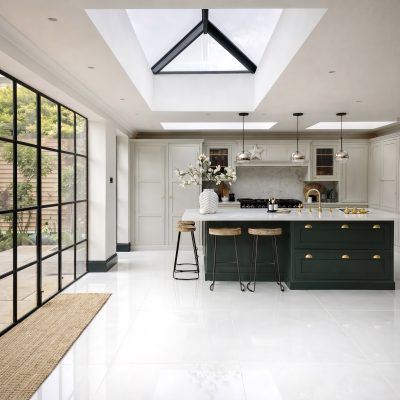
The floor takes more daily punishment than almost any other surface in the house, so it’s worth choosing it for practicality first and look second – fortunately, the two rarely have to be at odds.
Porcelain kitchen floor tiles – why they’re the top choice
Porcelain is the default material for UK kitchen floors, and the reasons are mostly practical rather than aesthetic. It scores 7–8 on the Mohs hardness scale, so everyday scratches from dropped cutlery or dragged chair legs simply don’t register, and it’s rated PEI class 4–5 for abrasion resistance, which covers even heavy daily foot traffic without issue.
Water absorption sits below 0.5%, which makes porcelain kitchen floor tiles practically indestructible against spilled sauces, grease and the kind of cleaning products that would stain a softer material.
The format range is genuinely wide too, running from compact 30×30cm tiles right through to large 60×120cm or 120×120cm slabs. At Top Ceramics, porcelain floor tiles start from around £20/m², though it’s worth checking the current catalogue for exact pricing on the specific range you’re after.
Wood effect tiles for kitchen floors
Wood-effect (or timber-look) tiles give you the warmth of a wooden floor with none of the maintenance headaches, since they’re porcelain underneath the printed surface. The most popular sizes are deliberately narrow and elongated to mimic the proportions of a real floorboard.
They suit rustic, Scandi and farmhouse-style kitchens particularly well, and the practical upside over real wood is significant: no water absorption, no swelling or warping near the sink or dishwasher, and the same easy wipe-clean maintenance as any other porcelain floor.


Large format vs small format kitchen floor tiles
Large formats – 60×60cm and 60×120cm being the most common – mean fewer grout lines, which translates directly into easier cleaning, a more contemporary look, and a kitchen that feels visually bigger than its actual footprint. The catch is that they demand a genuinely flat subfloor and are considerably harder to install as a DIY project, since even small inconsistencies become obvious across a bigger tile.
Smaller formats – 30×30cm or 33×33cm – are far more forgiving to lay yourself, come in a wider range of patterns, and tend to suit smaller kitchens better. As a rule of thumb, in a kitchen under around 8m², large formats can start to feel overwhelming rather than spacious.
Anti-slip tiles for kitchen floors
A kitchen is, by definition, a wet zone – spills, steam and the odd dropped ice cube are part of daily life – so slip resistance matters more here than almost anywhere else in the house.
Look for the R-rating on any floor tile you’re considering: R9 is the minimum and offers light slip resistance suited to shoes on a mostly dry floor, R10 copes with bare feet and occasional dampness, and R11 provides a higher level of safety again, which is worth considering if you’ve got young children or simply want extra peace of mind.
Have a look at the full kitchen floor tiles range to compare porcelain, wood-effect and anti-slip options side by side.
Kitchen wall tile ideas
Beyond the splashback and the floor, the rest of the kitchen’s wall tiling is where colour and personality really come through – and it’s worth thinking about as its own decision rather than an afterthought.
Grey kitchen wall tiles
Grey remains one of the most popular wall tile colours in UK kitchens, and it’s easy to understand why – it’s neutral enough to work with almost any scheme, modern without trying too hard, and genuinely easy to style around.
You’ll find it across light grey, deeper charcoal and concrete-effect finishes, and grey kitchen tiles sit comfortably alongside white, anthracite or wood cabinetry without ever looking like the wrong choice.
Finish matters as much as shade: matte grey hides everyday smudges and watermarks well, while gloss bounces light back into the room but shows fingerprints rather more readily.


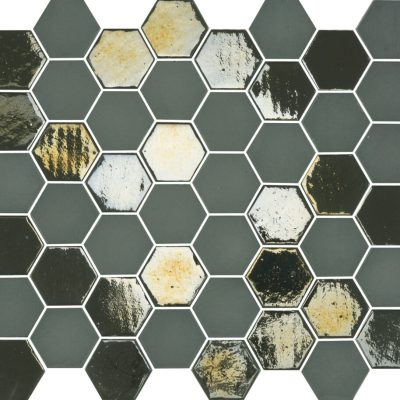
Black kitchen wall tiles for a modern look
Black on a kitchen wall makes a genuine statement, and it’s a trend that shows no sign of slowing down through 2026. It tends to work best in a contained way – as a splashback, an accent behind the worktop, or tiling one specific zone rather than every wall in the room.
Grout choice changes the character completely: black kitchen wall tiles paired with a light grout create a strong graphic grid, while black tile with black grout disappears into a single, minimalist plane.
Worth a word of caution, though – in a small or naturally dark kitchen, black tiles across every wall can tip from dramatic into overwhelming, so it generally earns its place best as a deliberate accent rather than a full commitment.
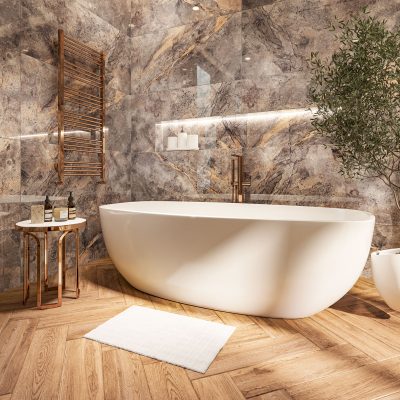


Pink kitchen tiles – on trend in 2026
Pink has come a long way since its slightly fraught 1980s reputation – today’s versions lean towards dusky pink, terracotta-pink and soft blush rather than anything bubblegum-bright.
Pink kitchen tiles pair particularly well with sage green cabinetry, natural materials like rattan and untreated wood, and warm brass hardware, all of which soften the colour rather than letting it dominate.
Popular formats include blush-pink metro tiles (10×20cm), pink hexagon mosaics, and encaustic-pattern tiles that incorporate pink as one of several tones. If the colour appeals, our full range of pink kitchen tiles is worth a browse for the full spread of shades and formats currently available.


White tiles – the timeless kitchen wall choice
If you’d rather not commit to a trend at all, plain white remains the safest long-term choice for kitchen walls – it brightens the room, suits literally any cabinet colour going, and has never once looked dated in the way bolder colours sometimes do a decade later.
Most commonly it shows up as gloss metro or plain large-format squares, though matte white has been gaining ground for kitchens that want a softer, less clinical finish.
The one practical downside worth knowing: white shows grease splashes and watermarks more readily than grey or patterned tile, so it benefits from a quick wipe-down as part of the daily routine, and a slightly warm-toned or pale grey grout, rather than stark white, that hides everyday marks more forgivingly.
Browse the full kitchen wall tiles range to compare colours, finishes and formats before deciding.


Kitchen tile colour guide
Once you know your cabinet colour, choosing a tile that works with it gets a lot more straightforward – most combinations boil down to a handful of dependable pairings rather than endless possibilities.
Tiles to go with a white kitchen
White cabinetry is the most flexible base there is, which is precisely why it can also be the hardest to make interesting – almost any tile “works”, so the real decision is which direction you want the kitchen to lean.
A pale grey or concrete-effect tile keeps things calm and contemporary; a sage green or terracotta splashback adds warmth and personality without fighting the cabinets; and a black or charcoal feature wall, used sparingly, gives an otherwise all-white kitchen some real definition.
Tiles to go with a green kitchen
Green – particularly sage green – has been one of the defining UK kitchen cabinet colours for several years now, and it’s genuinely forgiving when it comes to tile pairings.
White or cream tiles create a classic, slightly traditional look that’s difficult to get wrong; dusky pink adds a softer, more romantic feel; while terracotta paired with brass fittings brings warmth and a Mediterranean-inspired character.
If you’re looking for more inspiration, read our guide on what colour tiles with a green kitchen, where we explore the best tile colours, shades and finishes to complement green cabinetry.
Dark or navy cabinetry tends to need a tile that does some of the brightening work the cabinets themselves can’t. White or pale grey tiles are the reliable choice, lifting the whole room and stopping it from feeling heavy. Marble-effect tiles in white or pale grey add a touch of contrast and texture rather than flat colour, and brass or gold fittings alongside either option lift the scheme further without needing to change the tile at all.
Tiles to go with wooden kitchen units
Wood cabinetry, whether a warm oak or a paler ash, pairs naturally with plain white or cream tiles for a classic, light-filled finish that lets the timber do the talking. Terracotta or rust-toned tiles bring out the warmth in the wood for a more rustic, lived-in feel, while sage green sits comfortably alongside timber for a softer, Scandi-leaning kitchen that feels calm rather than busy.
Conclusion
Kitchen tiling is about much more than choosing a colour you like. The best results come from balancing practicality, budget and style, whether you’re looking for a scratch-resistant porcelain floor, a statement splashback or wall tiles that complement your cabinetry. By planning carefully, measuring accurately and thinking about how each surface will be used day to day, you can create a kitchen that looks beautiful and stands up to the demands of everyday life.
From timeless metro tiles and elegant herringbone layouts to contemporary large-format porcelain and bold patterned designs, there is a solution for every type of kitchen. The key is to choose materials and layouts that suit both your space and your lifestyle.
FAQ
What are the best tiles for a kitchen splashback?
Metro tiles are the most popular and dependable choice for a splashback, offering easy installation and a classic look in almost any colour. If you want more visual interest, patterned, herringbone or mosaic tiles all work well too – the right option really depends on how bold you want that one wall to be.
Can I use wall tiles on a kitchen floor?
Generally, no. Ceramic wall tiles are fired at a lower temperature and aren’t dense enough to cope with foot traffic, dropped pans or daily wear, and they’re likely to crack or chip over time if laid on a floor. Porcelain tiles, by contrast, are dense enough for both walls and floors, so if you want one consistent look throughout, choose a porcelain range that’s rated for floor use.
What colour kitchen tiles are in style in 2026?
Pink and black are both having a real moment as accent choices, sage green continues to dominate as a cabinet colour with white, cream or terracotta tiles alongside it, and grey remains the dependable, easy-to-style neutral that never quite goes unfashionable.
How much does kitchen tiling cost in the UK?
Materials alone typically range from £10–£20/m² for budget tiles up to £40–£80+/m² for premium ranges, with labour adding roughly £20–£40/m² or £150–£300 a day for a tiler. A fairly typical kitchen – around 12m² of floor plus a 3m² splashback – usually comes to between £600 and £1,200 in total for materials and labour combined.
Do kitchen floor and wall tiles need to match?
No – they just need to feel connected. A shared grout colour, a matching undertone, or one material echoed in both (porcelain underfoot, a complementary colour on the wall) is generally enough to make floor and wall tiles feel like part of the same considered scheme, even when they’re not identical.